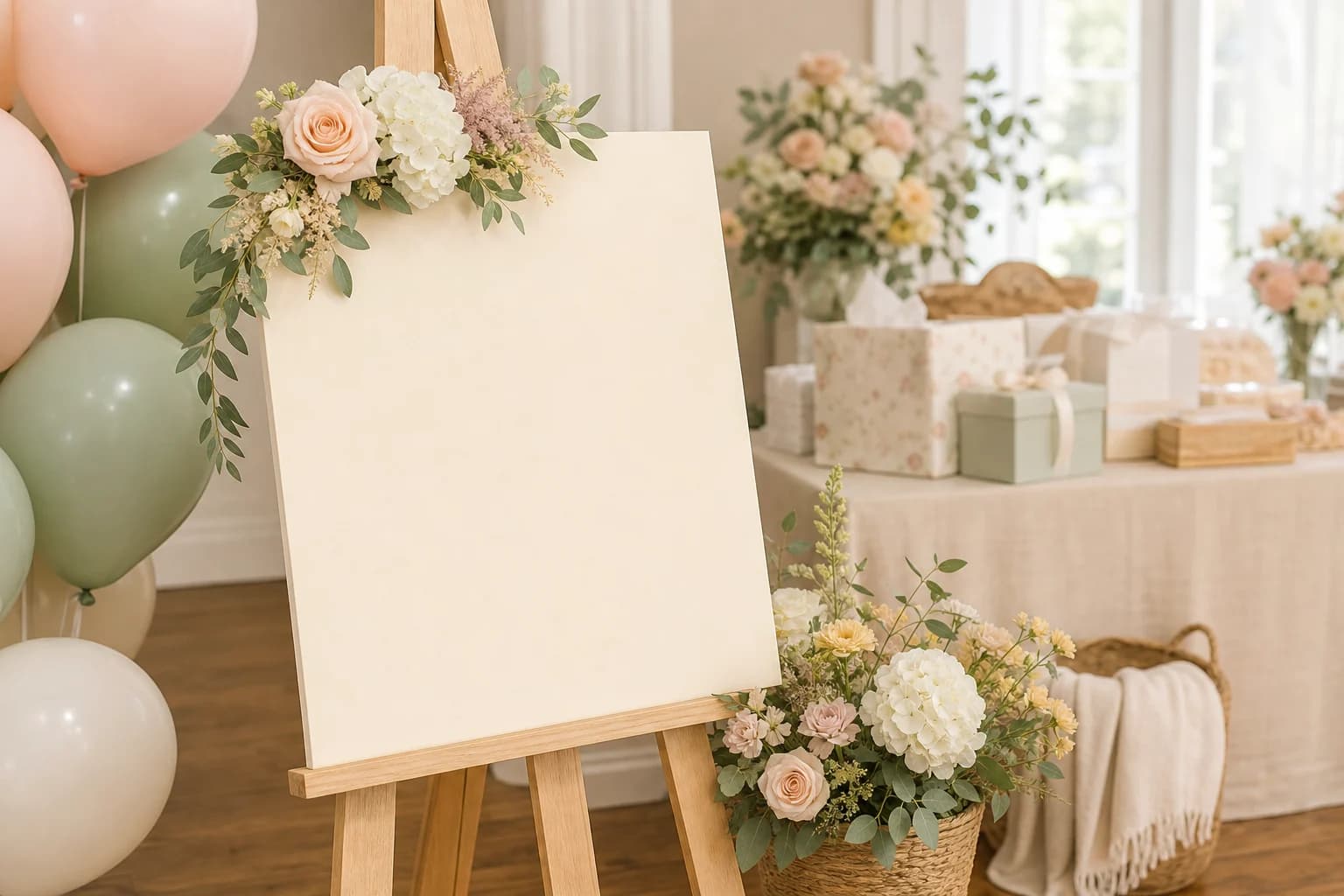
TL;DR: A good baby shower welcome sign is one guests can read in a single glance from the door, and it needs only three things: a clear welcome, the parent or baby name guests will recognize, and language that confirms they found the right celebration. Add the date or theme line only if it improves the design. Keep directions, gift instructions, hashtags, and the order of events on separate signs so the entrance message can be read in one glance.
The welcome sign is not a tiny invitation enlarged onto foam board. It has a different job. The invitation tells guests when and where to arrive; the sign reassures them that they are at the correct door, sets the visual tone, and moves them into the room without creating a bottleneck.
The three-line formula
- Line 1: Welcome or a short theme phrase.
- Line 2: Celebrating [Name] or Welcome to [Name]’s baby shower.
- Line 3: The date, Baby [Last Name], or one small supporting phrase.
What to put on a baby shower welcome sign
Start with the name guests used on the invitation. If most people know the guest of honor as Maya but the formal invitation says Mayara, the entrance sign should probably say Maya. Recognition beats formality at the door. For a shower honoring two parents, name both: Celebrating Maya & Jordan. For an adoptive family, a sip-and-see, or any gathering where pregnancy language does not fit, keep the wording centered on welcome and celebration.
| Element | Use it when | Skip it when |
|---|---|---|
| Welcome | Almost always; it explains the sign immediately | A theme phrase already functions as the welcome |
| Parent name | Guests know the parent better than the baby name | The family prefers privacy in a public or shared entrance |
| Baby name | The name has been announced and the family wants it used | The name is private, undecided, or a surprise |
| Date | The sign will become nursery or memory-book decor | The third line makes the layout crowded |
| Theme phrase | It is short and instantly understandable | Guests need to decode a pun before finding the name |
Do not put the registry URL, diaper-raffle rules, food labels, or a full schedule on this sign. Those messages belong where the action happens: raffle wording near the tickets, food information on the buffet, and the order of events with the host. One entrance board cannot be a welcome, directory, menu, and instruction manual at once.
Welcome sign wording by theme
Use these as starting points, not mandatory scripts. Replace names and pronouns to match the family. The clearest option is often the shortest one.
| Theme | Headline | Supporting line |
|---|---|---|
| Classic | Welcome to Maya’s Baby Shower | Celebrating Baby Rivera |
| Little cutie | A Little Cutie Is on the Way | Celebrating Maya & Baby |
| Woodland | A Little Adventure Begins | Welcome to Jordan’s Baby Shower |
| Wildflower | Our Family Is Growing Wild | Celebrating Maya & Jordan |
| Locally grown | Locally Grown With Love | Welcome, Friends & Family |
| Storybook | A New Chapter Is About to Begin | Celebrating Baby Chen |
| Moon and stars | Over the Moon for Baby | Welcome to Amara’s Shower |
| Bee | A Little Honey Is on the Way | Celebrating the Patel Family |
| Ocean | A Little One Is on the Horizon | Welcome Aboard |
| Brunch | A Baby Is Brewing | Brunching for Maya & Baby |
| Co-ed | Welcome, Everyone | Celebrating Maya, Jordan & Baby |
| Sip-and-see | Come Meet Baby Noa | We’re So Glad You’re Here |
If you have not chosen a theme, use the classic wording. A welcome sign does not need a pun to feel finished. If you have, borrow the colors and one motif from the baby shower theme, then let the name remain the visual focus.
Choose the wording by family situation
- One parent named: Welcome to Maya’s Baby Shower.
- Two parents named: Celebrating Maya & Jordan and Their Growing Family.
- Baby name private: Welcome to the Riveras’ Baby Shower.
- Baby name announced: We Can’t Wait to Meet Baby Noa.
- Second baby or sprinkle: A Little Sprinkle for Maya & Baby.
- Adoption celebration: Love Makes a Family. Welcome to the Celebration.
- Sip-and-see: Welcome. Come Meet Baby Noa.
- Office shower: Celebrating Maya & Baby With the Whole Team.
Use the language the family uses for itself. Do not surprise anyone with a baby name, surname, honorific, pregnancy reference, or gendered phrase they have not approved. Send the exact three lines to the guest of honor before printing; a screenshot is better than an informal “looks good” in a group chat.
Make it readable from the doorway
Adobe Express’s typography guidance starts with readability, clear hierarchy, and restraint with font combinations. That matters more on a physical welcome board than on a phone screen because guests are approaching while moving, talking, and looking for the door.
- Make the name or main welcome line largest. Theme art should frame the message, not compete with it.
- Use decorative script once. Keep the smaller lines in a clean serif or sans serif. Adobe recommends balancing decorative type with simpler text for legibility.
- Keep strong contrast. Pale blush text on cream may match the invitation and disappear across a foyer. Use the darker shade from the palette for the words.
- Print a test at home. Tape a letter-size proof to a wall and stand across the room. If the names are not instantly clear, simplify before paying for the large print.
- Leave breathing room. The blank space is doing useful work. It lets the welcome read before the flowers, animals, or stars are noticed.
Host tip: Ask someone who has not seen the design to look at it for three seconds. Then hide it and ask what the event is and whose name appeared. If they cannot answer both, the sign is decorating before it is communicating.
Where to put it and what size to choose
Place the sign where the decision happens: before guests choose a door, hallway, or garden path. At a private home, that may be the porch or first visible wall inside. At a restaurant or shared venue, place it near the host stand with the venue’s permission. Do not block a walkway, handrail, doorway, or accessible route with the easel.
For a small home shower, an 18-by-24-inch board is usually enough when the copy is short. A 24-by-36-inch board earns its size in a large room or shared entrance. Those are practical starting points, not rules. Mock the dimensions with painter’s tape at the venue before ordering. The correct size is the smallest one that guests can recognize from the point where they need reassurance.
What most people get wrong
They make the sign match the invitation instead of match the doorway. Invitation details are read up close and at leisure. A welcome board is scanned from several steps away. Carry over the palette and motif, but cut the copy until the event and name win the first glance.
Once the entrance is solved, move the other messages to smaller task-specific signs: cards and gifts, guest book, favors, food labels, and games. The baby shower planning checklist helps place those pieces, and our digital baby shower games keep the activity portion off the printer entirely.
FAQ
What should a baby shower welcome sign say?
The safest wording is: “Welcome to [Name]’s Baby Shower,” followed by the date or “Celebrating Baby [Last Name].” A theme phrase can replace the first line as long as the parent or family name remains easy to find.
Do you put the baby’s name on the welcome sign?
Only if the family has announced the name and wants it displayed. Otherwise use the parent names, family surname, or “Baby [Last Name].” Confirm the final wording before printing.
How big should a baby shower welcome sign be?
For many home showers, 18 by 24 inches works with short, high-contrast copy. Larger or shared venues may benefit from 24 by 36 inches. Test the planned dimensions at the entrance and choose by viewing distance, not by a universal rule.
Does a baby shower need a welcome sign?
No. It is useful when the entrance is shared, the party is outdoors, or the decor needs a focal point. At a small home where the correct door is obvious, a simple arrangement at the entry can do the same job.
Sources
- Adobe Express — Typography Examples and Readability Principles (readability, hierarchy, limited font combinations, and balancing decorative type with clean supporting text)
- Adobe Express — Poster Design Ideas (high contrast, distinct text hierarchy, and avoiding clutter in printed display design)
- Canva — Designing Digital and Printed Event Invitations (type choice communicates event tone; font pairing should balance contrast, hierarchy, and cohesion)