TL;DR: The Price Is Right baby shower game is dead simple: the host shows a series of common baby products one at a time, every guest writes down a price guess, and the guess closest to the real retail price without going over wins the round. Tally rounds, and the guest with the most wins takes home a small prize. You need about 8–12 items, a way to show them (a printed photo or a screen), and a hidden answer key. Below: the exact rules, an item cheat-sheet, scoring, and the two ways hosts run it.
Most "how to play" results hand you a 50-product list and never tell you the actual mechanics — how many items, who wins a tie, whether you show the prices or hide them. This is the run-of-show: setup, the rounds, scoring, and the variations, so you can host it cold.
Key takeaways
- Closest without going over wins. That single rule is the whole game — a guest who guesses over the real price is out for that round.
- One point per round. Most correct (or closest) guesses across all items wins overall.
- 8–12 items is the sweet spot — enough rounds to be fun, short enough to stay snappy (~15 minutes).
- Works in person or on Zoom. A shared screen makes it identical for both — no printing required.
What you need before guests arrive
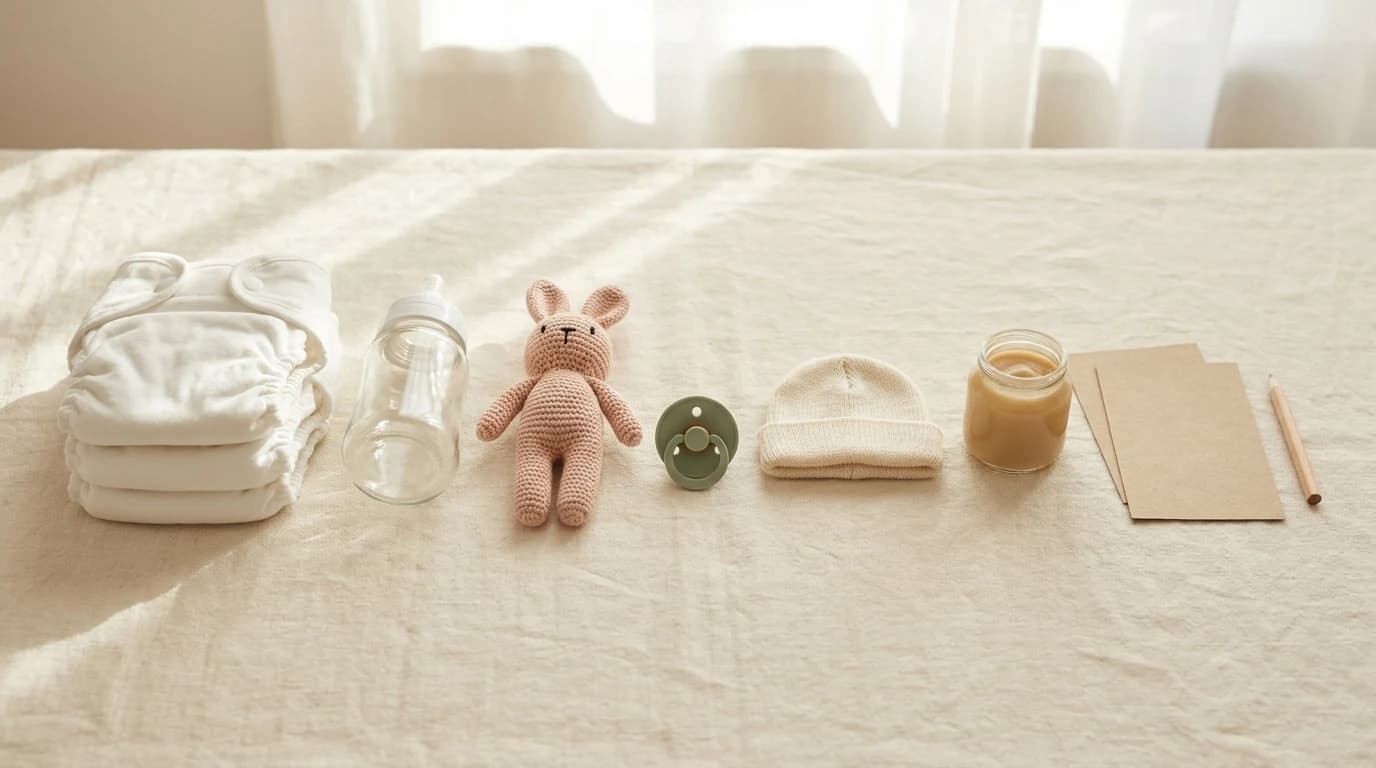
The Price Is Right is a prep-then-play game: a little setup beforehand, almost no effort during. As Pampers describes it, you "choose a few common baby-related products," note the real price of each, and "save images you can print or show on a screen." Here's the full setup list:
- 8–12 real baby products with their current retail prices (pull them from the registry, a catalogue, or a store website).
- A way to show each item — printed photos, or images displayed on a TV, laptop, or tablet so the room can see them.
- A hidden answer key with the real prices. Keep it out of sight; this is the part nosy guests will try to peek at.
- Guess slips and pens — one per guest, or a shared whiteboard for a small group.
- One small prize for the overall winner (a candle, gift card, or cozy socks all work).
Host tip
Mix easy items (a pacifier, a onesie) with big-ticket surprises (a stroller, a crib). The whole laugh of the game is people wildly under-guessing the expensive stuff and over-guessing the cheap stuff.
Good items to use (and their price range)
Aim for a spread of prices so the guessing stays interesting. A reliable lineup:
| Price tier | Item ideas | Why it works |
|---|---|---|
| Under $15 | Pacifier, onesie, bib set, baby socks, board book | Guests over-guess small things |
| $15–$50 | Diaper box, bottle set, swaddle, sound machine, bath tub | The "I have no idea" middle zone |
| $50+ | Stroller, crib, car seat, baby monitor, high chair | Big reveals get the biggest gasps |
How to play, step by step
The rules are short. Pampers and game-guide sources agree on the core flow:
- Show one item. The host displays a single product and gives a quick one-line description. Only the host can see the answer key.
- Everyone guesses silently. Each guest writes down their best estimate of the retail price — no conferring, no shouting it out.
- Reveal and score the round. The guest whose guess is closest to the real price without going over wins that round and earns a point. (Go over, and you can't win that round — same as the TV show.)
- Repeat for every item, then tally points. The guest with the most round wins is the overall winner and gets the prize.
The one rule that runs the game
Closest without going over. If the real price is $24 and three guests say $20, $23, and $26, the $23 wins — $26 is over and out. This is what makes it feel like the show and stops a single wild high guess from accidentally winning.
The two ways hosts actually run it
There are two clean formats, and the right one depends on whether you want fast or precise:
| Open guess | Multiple choice | |
|---|---|---|
| How it works | Guests write any number | Pick from ~6 price options |
| Best for | A competitive crowd | Big or mixed-age groups |
| Scoring | Closest without going over | Exact match = the point |
The multiple-choice version (each item shows about six price options, one correct) is the easier one to run for a screen-share crowd — guests just call out a letter, and you reveal the right one in green. The open-guess version is more of a real contest but takes a bit more tallying.
Playing it virtually (or on a TV)
This game travels to a screen better than almost any other. There's nothing to pass around — the host just shares one screen and everyone sees the same item. For a virtual or hybrid shower, display each product, ask for guesses in the chat or out loud, then reveal the price. The number of players doesn't matter; it works for three guests or thirty.
If you'd rather skip building a slideshow, our on-screen Price Is Right: Baby Edition game has the items and prices ready to play on any TV or video call — no printing, no answer key to hide. You can browse all 20 games too, and the how many games to play guide will keep your lineup tight.
What most people get wrong
They drop the "without going over" rule and just give the point to whoever's number is nearest in either direction. That's a different (easier) game — and it lets one person who guesses absurdly high sweep a round. Keep the over-rule: it's the whole reason the game feels like the show, and it rewards careful guessers over loud ones.
FAQ
How many items should the Price Is Right baby shower game have?
Eight to twelve is the sweet spot — enough rounds to build a real score, short enough to stay around 15 minutes. Fewer than six feels over too fast; more than fifteen drags.
What's the exact winning rule?
For each item, the closest guess to the actual retail price without going over wins that round. After all items, the guest with the most round wins is the overall champion.
How do you break a tie?
Add one tiebreaker item with a tricky price, or settle it on the spot with a coin flip — don't buy a second prize just for a tie.
Can you play it at a virtual baby shower?
Yes — it's one of the best virtual games because the host just shares one screen. Show each item, collect guesses in the chat, then reveal the price. The number of players doesn't matter.
Do you have to use real prices?
Yes — pull current retail prices from the registry, a store site, or a catalogue. Prices drift, so check them close to the shower date rather than reusing an old list.
Sources
- Pampers — Price Is Right Baby Shower Game (pick common baby products and note their prices; show each item one at a time with a short description; guests write a price estimate; "the guest whose guess is closest to the actual retail price, without going over, earns a point"; award a small prize to the overall winner)
- WebBabyShower — The Price Is Right Baby Shower Game Guide (three or more players, no upper limit; host is the only one who shows items; each player guesses without discussing; closest without going over is correct; multiple-choice version shows six price options, reveal correct in green; player with most correct answers wins)