Quick answer
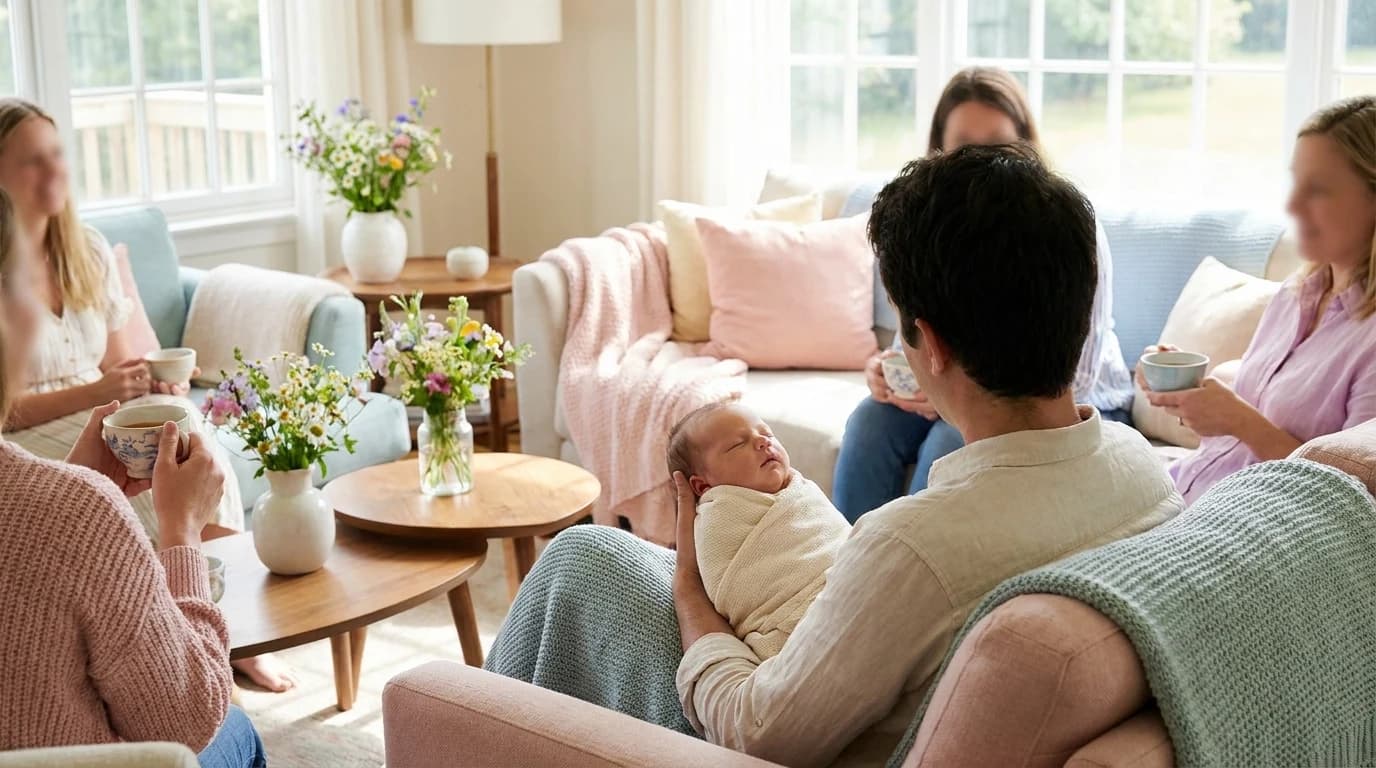
A sip and see is a relaxed get-together held after a baby arrives, where friends and family drop by for a drink and a first look at the newborn. Babylist describes it as a party that “happens after the baby is born,” any time in the first weeks or months, and it works after a birth or an adoption.
Think of it as an introduction, not a second shower. Lizzie Post of the Emily Post Institute told WISN that new parents schedule one instead of having “a ton of visitors” arrive one after another, so they can be rested for a single, planned window. Babylist notes the tradition was historically popular in the southern US. Today it turns up everywhere.
Shower vs sprinkle vs sip and see
The three get mixed up because they overlap. This matrix sorts them on the questions guests actually ask. The etiquette rows are conventions, not rules: where a source says it, we name the source; the rest is our recommendation.
| Baby shower | Sprinkle | Sip and see | |
|---|---|---|---|
| Timing | Before birth | Before birth, usually a later baby | After birth or adoption |
| Who usually hosts | A friend or relative | A friend or relative | Often the parents at home; a helper is better (our pick) |
| Gifts expected? | Yes, usually off a registry | Small basics, like onesies | Optional: Post says a card or small gift is fine |
| Baby present? | No | No | Yes, that is the point |
| Typical length | A few hours | Often shorter and smaller | Babylist: about an hour, longer if parents feel up to it |
| Best for | A first baby who needs everything | A second or third baby, a big age gap | Later babies, kept-secret sex, adoption, a high-risk pregnancy, a family that skipped the shower |
Post put the difference neatly: a shower is about getting the parents set up, while a sip and see is “much more about ‘come and meet the baby.’” For the other formats, from diaper parties to gender reveals, see types of baby showers explained. If the question is whether a later baby gets a party at all, start with should you have a second baby shower.
When to hold it
Babylist’s window is broad: “the first few weeks or months.” We would not pick a date before the baby is home and the family has a rough feeding rhythm. Two more cases call for patience:
- A premature baby or a NICU stay. Babylist says it’s “totally fine to push out” the date. Let the parents and their pediatrician choose it.
- Cold and flu season. Babylist suggests waiting until illnesses have passed. A spring date is a perfectly good sip and see.
We could not find a medical source that names a specific week for meeting visitors, so we won’t invent one. That call belongs to the parents and their baby’s doctor.
Who hosts, and what to say on the invite
Parents often host their own, since it is held at home and nobody is collecting gifts for themselves. Even so, a grandparent or close friend taking over the food, door and dishes makes the day far easier on someone a few weeks postpartum. The usual hosting conventions are in who hosts a baby shower.
Put an end time on the invite. Babylist recommends invitations include “a specific end time.” Something like: Come meet Baby Noa. Sunday, 2 to 3:30pm. Please stay home if you’re feeling unwell. More wording help is in what to put on a baby shower invitation, and door-sign lines are in baby shower welcome signs.
Gifts: optional, and small
Lizzie Post told WISN, “I don’t think you have to bring gifts to a sip and see,” adding that a card or a smaller gift is fine. Babylist expects friends will want to bring something anyway. Our advice for guests: a card, a meal for the freezer, or a book for the baby’s shelf. Parents who already had a shower don’t need to open gifts in front of anyone. The thank-you rules are in baby shower gift etiquette.
Newborn health rules for guests
This is the section that separates a sip and see from every other party. A young baby is still building protection, and the CDC is specific about the people around them.
Ask every guest to
- Be up to date on vaccines. The CDC says family and caregivers should be current “to form a circle of disease protection around the baby.” Babies don’t start their own whooping cough vaccines until they are 2 months old.
- Get any needed shots early. Per the same CDC page, anyone who needs the whooping cough or flu vaccine should get it at least two weeks before meeting the baby. An adult who already had a Tdap does not need another.
- Stay home if sick. The CDC’s RSV guidance is plain: stay away from others when you are sick.
- Wash before holding. Babylist suggests a hand-washing station so guests can clean up before they hold the baby.
- Skip the face kisses. The CDC lists kissing a child’s face as one way RSV spreads.
Because of that two-week window, send invitations about a month ahead. It gives guests time to check their records with their own doctor.
A 90-minute plan
Short, standing, easy
- Arrivals (0:00 to 0:20). Coats off, hands washed, drinks poured. Baby stays with a parent, not passed around the room.
- Meet the baby (0:20 to 0:50). Small groups come to the parent, two or three at a time.
- Mingle and eat (0:50 to 1:15). Finger food that needs no knife and fork; quantities are in our menu by headcount guide.
- One light game, if any (1:15 to 1:30). A quick round of Old Wives’ Tales or baby facts trivia on the TV gives guests something to do while the baby naps. Then a clear goodbye at the end time.
The best sip and see is the one the parents barely have to host.
Frequently asked questions
Can you have a sip and see and a baby shower?
Yes. They do different jobs: the shower equips the parents, the sip and see introduces the baby. Keep gifts optional at the second one.
Is a sip and see only for second babies?
No. It suits any baby, including a first baby whose parents skipped the shower, an adoption, or a family that kept the sex a surprise.
Do kids come to a sip and see?
That is the parents’ call. If they do, the same rules apply: healthy, washed hands, no face kisses.